
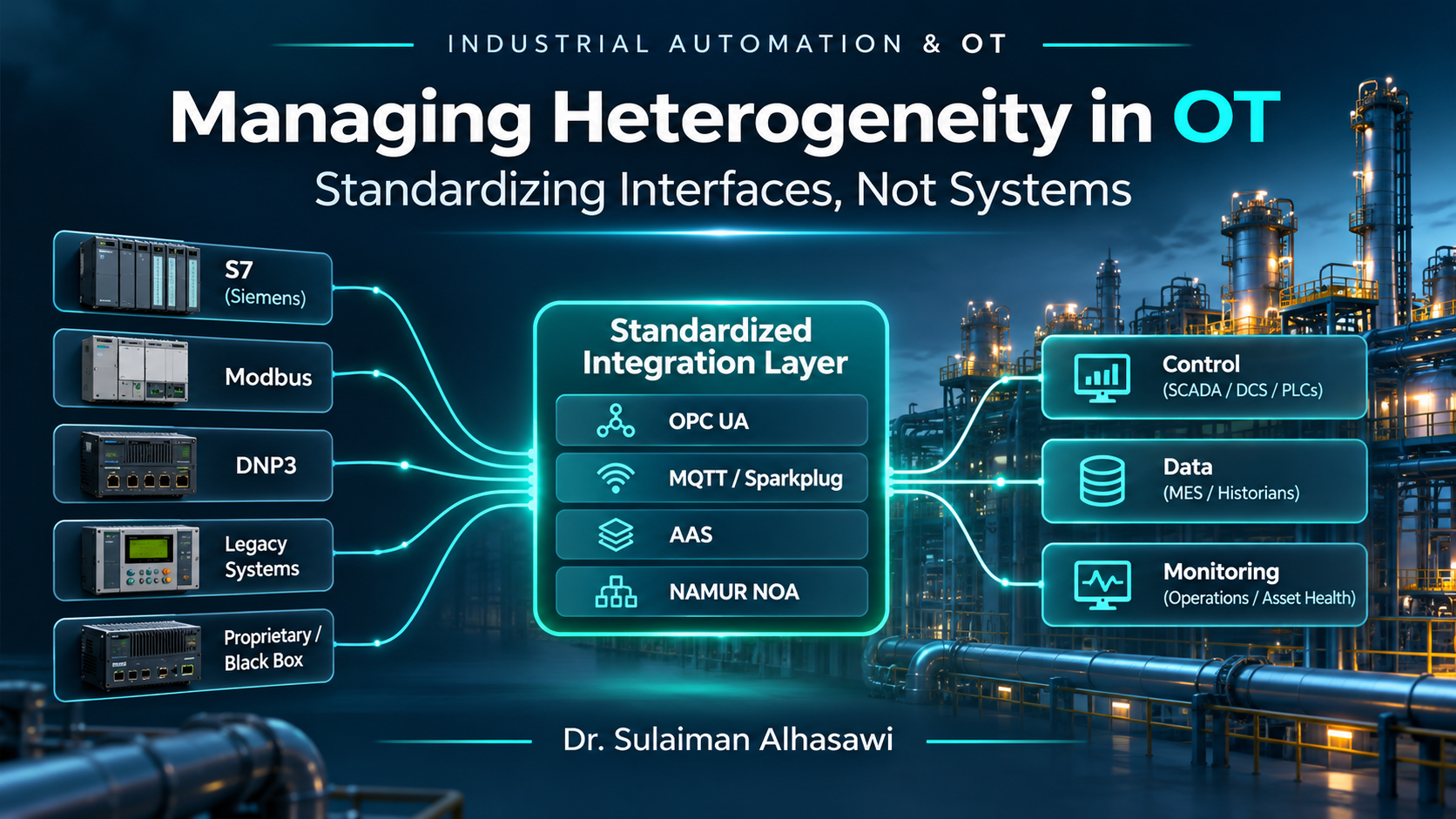
During my participation at the Cybersecurity Education & Research Conference (CERC 2026), I was asked an interesting question: How can we address the heterogeneous nature of Operational Technology (OT) systems, considering the diversity of industrial protocols, proprietary technologies, legacy equipment, and black-box systems?
This question encouraged me to explore the existing technologies and architectural approaches addressing this challenge. The information presented in this article was gathered through AI-assisted research and collaboration, combined with my own professional perspective.
Heterogeneity Is in the DNA of OT
Industrial environments have evolved over decades. Within a single facility, we may encounter equipment from different manufacturers, proprietary communication protocols, different operating systems, and technologies separated by several generations.
Unlike IT, replacing these systems is not always technically, operationally, or economically feasible.
In my opinion, the objective should not be to eliminate heterogeneity but to manage it.
Standardize the interfaces, not necessarily the systems.
Connectivity Is Not Interoperability
Consider three industrial devices measuring temperature:
- A Modbus device uses Register 40001.
- A PLC uses a variable called TEMP_PV.
- A proprietary controller uses Sensor_01.
Even if we establish communication with all three devices, understanding the meaning of their data remains a separate challenge.
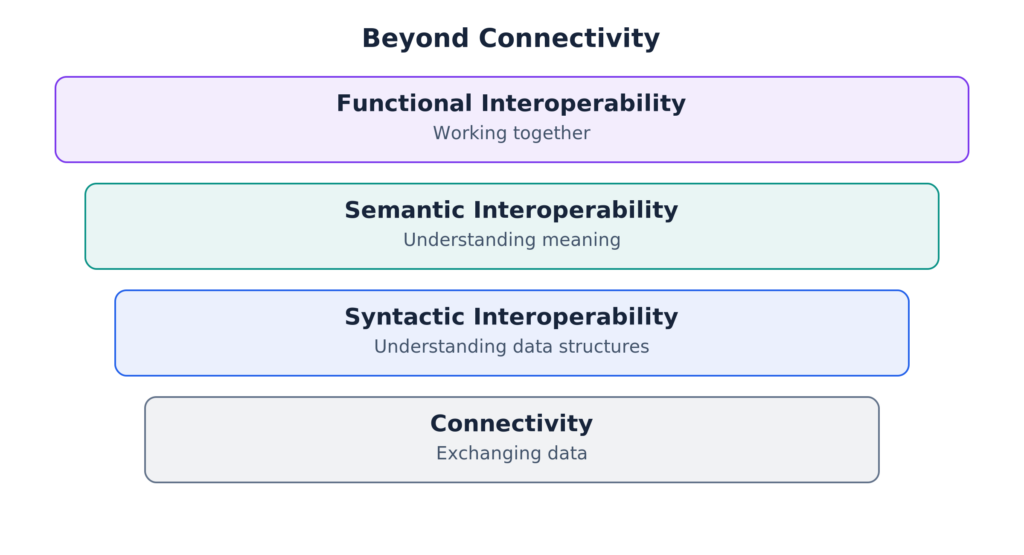
This illustrates the distinction between connectivity, syntactic interoperability, semantic interoperability, and functional interoperability.
Connecting systems is only the first step. Enabling them to understand and work with each other is the greater challenge.
How Are We Addressing This Challenge Today?
Several existing standards, technologies, and architectural approaches address different dimensions of industrial heterogeneity.
| Technology | Contribution |
|---|---|
| OPC UA | Vendor-independent communication and information modeling. |
| OPC UA Companion Specifications | Standardized representations of industrial equipment and its functions. |
| OPC UA FX | Cross-vendor interoperability at the controller and field levels. |
| O-PAS | Open process automation architectures that reduce vendor lock-in. |
| MQTT and Sparkplug | Common messaging interfaces and structured industrial data exchange, supporting architectures such as Unified Namespace (UNS). |
| Asset Administration Shell (AAS) | Standardized digital representations of industrial assets. |
| Module Type Package (MTP) | Standardized interfaces for integrating modular industrial production units. |
| NAMUR Open Architecture (NOA) | Protected access to industrial data without replacing existing core control architectures. |
| Ethernet-APL and TSN | Common network infrastructure and predictable industrial communication. |
| IEC 61499 and Universal Automation | Greater portability of automation applications across hardware platforms. |
These approaches are complementary rather than competing solutions. Each addresses a different layer of industrial heterogeneity, and their maturity and adoption vary.
A Practical Approach for Existing OT Environments
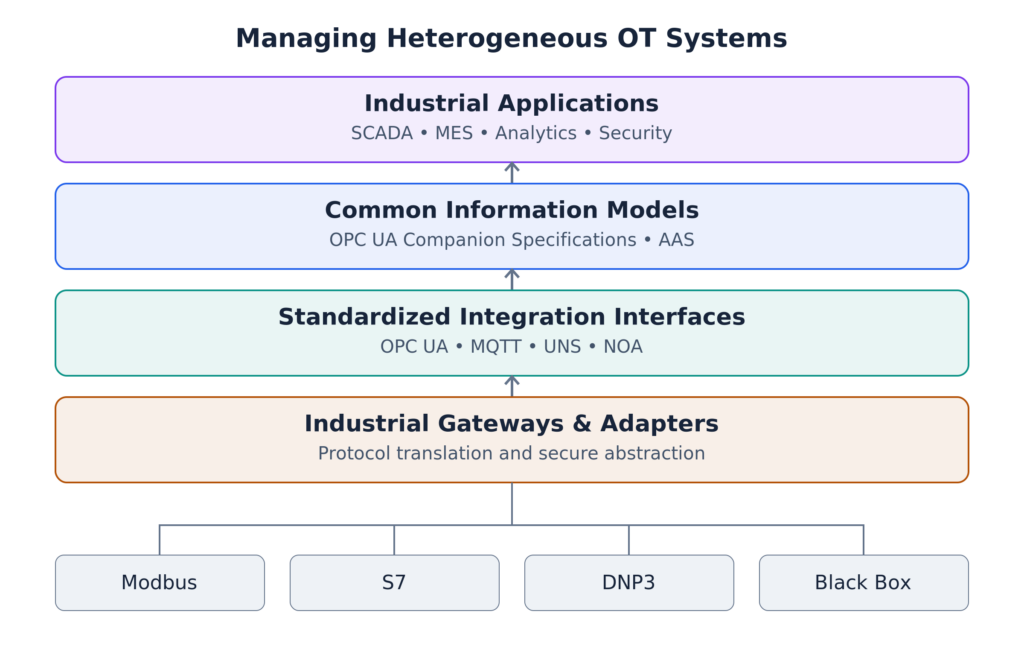
Rather than replacing an entire industrial environment, we can introduce layers of abstraction and standardization around existing systems.
Protocol gateways, industrial edge platforms, common information models, and standardized interfaces can enable existing equipment to participate in a more interoperable architecture while preserving its original control functions.
However, black-box systems with limited or unsupported interfaces may still require external monitoring, vendor cooperation, or compensating controls.
The Cybersecurity Perspective
Greater interoperability can improve asset visibility, monitoring, and security management. However, it can also introduce new attack surfaces and shared dependencies.
Industrial interoperability must therefore be accompanied by appropriate security boundaries, access controls, and risk management, following principles established by ISA/IEC 62443 and NIST SP 800-82.
Interoperability should never mean unrestricted connectivity.
Final Thoughts
I do not believe that industrial environments need to become homogeneous to become more manageable.
The technologies already available demonstrate that heterogeneity can be addressed through standardized interfaces, open architectures, common information models, and secure integration layers.
The challenge is not making every industrial system identical, but making different systems work together without compromising security, safety, or operational reliability.
The future of OT is not homogeneity. It is secure interoperability.